


SOURCE / CATEGORY: History
| № | 17.01.2023 (19.03.2018) |
[Inter- view, text] |
RESPONDENT: Sanasar Margaryan. INTERVIEWER: Alexander Andreasyan |
|||
| 1 | "Olympic champion from Artaxata". (Sanasar Margaryan has released a historical and artistic musical audiobook, which tells about the events of the 4th century AD) 🔷 | |||||
Sanasar Margaryan has completed work on a project about the events of world history and the history of Olympic sports related to Varazdat Arshakuni from Greater Armenia, who became an Olympian in 385 AD. at the 291st Ancient Games in Greek Olympia [1].
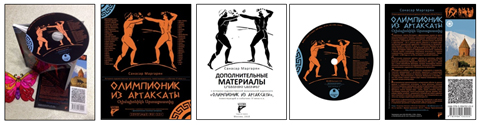
Listening to Audiobook and getting to know the Additional Materials for it, we not only 1) find out how the real Olympic Games were organized, but also 2) who banned them, 3) evaluate the various insidious and far-sighted decisions of the leaders of the countries of the Ancient World, 4) follow in detail how the competitions in fisticuffs and chariot races were held in Greek Olympia, 5) recall the school curriculum, where we were informed that the last of the reliably known winners of the 291st Games in 385 AD. became the fist fighter Varazdat from the Arshakuni dynasty, the former king of Great Armenia, 6) we will touch on the mentality of many of the peoples who lived in the 4th century AD, we will hear the state of their soul through folk music and works of both ancient and modern authors, 7) we will feel love and hatred of that time, 8) think about the meaning of "bread and circuses", 9) realize the purpose of the fights between bestiaries and animals, and much more, finally, 10) understand that each of us has been given our own mission, which is related to the well-being of people, their peaceful coexistence on planet Earth.
We talked with Sanasar Margaryan about his unique project, which he has been working on for about 10 years.
— What is this colorful edition?
— This is a set of 100 page books in a slightly smaller than A5 format - Additional materials for the audio book + DVD (in mp3) - a digital disc with a soundtrack of the narration itself, placed on the 3rd side of the printed edition.
— Is the reader familiar with your other work?
— With special works in the field of physics and sports (in football) - perhaps, but with historical works - no, since this is my first project.
— What is your education and where do you live?
— Higher education, graduated from the Moscow Engineering Physics Institute (MEPhI), I have been living in Moscow since 1982. I will also tell you an interesting fact from my biography: I graduated from a secondary school, which was built at the expense of the famous Russian writer Leo Tolstoy from the fee received from the novel "Resurrection", written in the period from 1889 to 1899.
— 10 years too?
— Yes, according to the numbers it turns out like this.
— You are a physicist, but the work you did is historical - how can this be?
— Yes, it happens, and I am not a pioneer in this, for example, Jules Verne was a lawyer, Haruki Murakami was a salesman in a record store, George Orwell and Leo Tolstoy were military men, Mikhail Bulgakov and Anton Chekhov were doctors, the list can be and continue on.
— How did you get the idea to take on the popularization of such a historical figure as the Armenian king from the Arshakuni dynasty?
— If we were talking about popularization, then it would be possible to simply replicate, for example, stickers with the desired hero, and this would be enough, but the idea that appeared in the 45th year of my life was more serious: I suddenly asked myself two simple questions : "Who am I?" and “What was he born for?”.
— Interesting…
Yes, yes! We, the people of planet Earth, consider ourselves, as you know, to be rational beings, and if so, then our mind, even without agreeing with us, sometimes asks one or another non-standard question.
— And how did you answer these questions?
— My answer to the first question is: “I am an Armenian!”, but the second one follows from the answer to the first, i. if I am an Armenian, it means that I have to do something for the benefit of Armenia or civilization, since an elementary analysis of the history of Armenia showed that Armenia is the cradle of world civilization! Yes, that's right - this is recognized by those deeds and deeds, including an outstanding contribution, related to various developments, without which life could not develop so technologically progressively for a modern person: without pita bread, color television, hair dryer, plastic surgery, concrete mixers on the chassis , oxygen masks, an ATM, an airplane, a moon rover, an automatic transmission, an MRI, etc., and if you want - without nuclear weapons and the Armenian Anna, the future Grand Duchess Anna of Byzantium, who baptized Rus' in 988 AD!
— A solid list…
Yes, and that's just a minuscule amount! And that's what it means - how to answer the question! It turns out, in fact, that I am an Armenian (and what is important, I also feel, according to my feelings), but after all, such competition - everyone can get scared!
There was no way out, and if at first I mechanically moved forward, not having the slightest idea what would happen next, then a few years later, in 2014, when it was decided to stop at the audiobook, the priest of the Moscow Armenian temple complex Ter Grigor ( in the world of Mher Beknazaryan), not only blessed the creation of the audiobook (for a number of conveniences), but also uttered the key phrase: “If an Armenian can do good and does not do it, he sins!” After which my way back was completely cut off: either I had to admit that I cannot do good, and then I sit quietly, and no one needs me, or I work for the good of world civilization (to put it pompously). Of course, I had to choose the second path, because the first is a regression not only of what is around, but also of the personality itself, i.e. myself, and this is not a very good prospect ...
Truly, the Armenian priests are the keepers of the age-old wisdom of their people, so they know what to say when it is necessary!
— How could you explain the concept of wisdom?
— I think the simplest explanation is determined by the formula: INT • GOOD = WISDOM, but there is also a reverse side of this coin: INT • EVIL = CLICK, and if the first case is the path to creation, then the second leads to destruction, and it is unlikely whether such a formulation can be argued.
— Returning to the idea of starting work on the project…
— After answering the questions about who I was and what I was born for, the task of applying my strength became, and it was found very quickly: a small Internet analysis showed that the Armenians, among other things, were the first and only foreign Olympians, victors at the ancient Games in Olympia - they were: Trdat III Arshakuni, the future king of Armenia, who won the fight in 281 AD. at the 265th Games (this is also confirmed by the dissertation of Professor M.S. Ispiryan), it was the king under whose reign Armenia in 301 AD. the first in the world to adopt Christianity as a state religion, and Varazdat Arshakuni, the former king of Armenia, who won in a fist fight in 385 AD. at the 291st Games in Olympia, about which we read in textbooks: “The last of their authentically known Olympionists of the ancient Games in Olympia was Varazdat from Armenia.”
The theme is sports, and for me it was interesting. It was 2008, the year of the Beijing Olympiad.
— And which of the Olympians did you choose?
Varazdata Arshakuni.
— Why, because Trdat III the Great was the more famous ruler of Armenia?
— It happened so - I just managed to find (through Ulan-Ude) Ashot Melik-Shakhnazarov's book "Olympionik from Artaxata" (1986), which became the basis for starting work on the project. Moreover, the plot of the story was so exciting that I, a middle-aged man, even moistened my eyes at certain episodes of the story. Then I considered my choice to be the right one, and, as time has shown, I was not mistaken. But the development of the theme of Trdat III the Great will give an equally amazing project!
— Ashot Melik-Shakhnazarov was a famous Soviet and Armenian diplomat.
— And not only, among other things, he was also an athlete (boxing, shooting, fencing), an international epee judge, the founder and first president of the Pan-Armenian Games, which were successfully held in Yerevan. These factors from his biography were important for obtaining the reliability of the information in the book he described, which was also confirmed by the author's son, Arsen Melik-Shakhnazarov, who said that his father worked, incl. with French and other sources.
— Did the author's son, Arsen Melik-Shakhnazarov, support your idea?
Yes, with great enthusiasm, as a worthy son of his father can do. Moreover, Arsen Melik-Shakhnazarov said that at one time attempts were made to stage an opera based on a book, but the premature death of his father violated these plans.
—There was information that you originally planned to make a feature film or a 3D animated feature film.
— This idea gleamed with hope for a long time, until it became clear that, first of all, there were no financial opportunities for it, despite the fact that all technical mechanisms were used to implement it, incl. publication on the website created for the project (olympionikvarazdat.ru or olympionikvarazdat.rf) of letters in 15 languages of the peoples of the world, inviting patrons, investors, sponsors and interested parties to take part in the project, as well as posting information about the project on a well-known crowdfunding platform, using way of collective financing based on voluntary contributions, all the most famous social networks were also involved, etc.
— Maybe it was necessary to directly contact the “Armenian fund holders”?
— There have been such attempts more than once, but numerous assistants and secretaries stand as a wall, in terms of protecting the “peace” of their boss. And this, of course, is bad, because no one encroaches on their peace - at least let them know what is happening around their persons.
— And our famous artists and directors - were they not interested?
— Perhaps interesting, but how could they know that there is such an idea?
I will give an example with our well-known Honored People's Artist Armen Borisovich Dzhigarkhanyan. I wanted to talk to him, because it was a serious matter - I needed advice: is it possible to implement such a project or is it a utopia?
I was interested in Dzhigarkhanyan's opinion after a conversation with Rodion Nakhapetov, who lives in the USA, whom, by the way, I easily got through to. Rodion Rafailovich literally said the following regarding my idea: “If you don’t have money, nothing will work, for example, I’m looking for funds to film the story of Andrei Platonov ...”. I am grateful to Rodion Nakhapetov that he personally picked up the phone and expressed his opinion.
But, as you know, any experiment involves at least three dimensions.
It was also important to talk with Armen Borisovich because he really is a wise person - I made such a conclusion by the strength and weight of the words that he utters. For comparison: there are empty talkers, the price of their word is 0 units, there are officials (dependent people on everyone and everything) - 2 units, there is Dzhigarkhanyan - 10 units. out of 10. This is my purely subjective opinion - but you can listen for yourself how this person formulates a thought without making long pauses, and at the same time having up to 2-3 seconds of time left for its formation (like a chess player), understanding that he is responsible for what he says! But in the end, to my great disappointment, numerous attempts to talk with Armen Borisovich Dzhigarkhanyan were in vain - all the same notorious secretaries and assistants working in the theater named after the artist did not let me do this!
But he will personally meet and talk with a professor at Moscow State University. M.V. Lomonosov Kuzishchin Vasily Ivanovich turned out easily and with pleasure. It happens that way too.
There was no point in experimenting further: it was necessary to work, since a feature film, cartoon or something else is a form, and the basis, the base of such work is the material itself, on which any script could be written.
— Did you plan to write the script yourself?
— This is how the situation turned out - this is the only way out, but since there could be “problematic” details, both in world history and in the history of sports, specialists in these topics were needed. In this case, I had a phone that was kindly provided by an employee of the National Olympic Committee (NOC) of Armenia, Yuri Aleksanyan - the phone of a sports chronicler, Doctor of Historical Sciences, Professor Mikael Ispiryan, who gladly agreed to become a project consultant.
From that moment on, I completely trusted Mikael Sisakovich, and did not even object when he insisted that women and girls were strictly forbidden to enter ancient sports competitions, even in the 4th century AD (therefore, as for example, the two heroines of the audiobook - Demeter and her maid Fata - had to be "dressed" in men's cloaks called "himation" and secretly "escorted" to the stadium), and that fist fighters competed naked, and much more.
I am extremely grateful to Professor Mikael Ispiryan for his invaluable help not only in matters of Olympic sports, but also in world and Armenian history, in particular. And to Alexander Chartilidi, who closes the Greek theme, and to many other scientists and specialists.
— How did you manage to compose such a complete picture of the narrative, because the audiobook voiced the events from the moment when Varazdat was held hostage, and up to his death?
— This was the main task, and the book of Ashot Melik-Shakhnazarov turned out to be very important, but still, only a segment of the history and history of sports, so I had to additionally refer to the book "Varazdat" by Stefan Zoryan (2008 edition). However, it soon became clear that this material was not enough. At the same time, the works of ancient chroniclers such as Pausanias, Movses Khorenatsi, Favstos Buzand, Hovhannes Draskhanakertsi, and others, as well as the developments of modern authors on this topic, were also studied in parallel.
But even after that, after all, I had to resort to my own research to resolve a number of issues that, in my opinion, were important for the historical narrative, which was the Olympionik of Artaxata.
— Do you mean questions that modern historians do not give a clear answer to?
— Yes, and as an example, I will give one of them: "Where exactly is the island of Tulis - the place of hard labor of Varazdat?".
— Is there an answer to this question?
There is an answer! And here they come to our aid: Ptolemy, "Geography of the 7th century A.D." Anania Shirakatsi, “History of Armenia” by Hovhannes Draskhanakertsi and… Heinrich Schliemann.
— Do you mean Heinrich Schliemann, who lived in the 19th century?
— Yes, it was him - an entrepreneur, a self-taught archaeologist and one of the founders of field archeology, who did the impossible - dug up in Asia Minor near the coast of the Sea of Marmara and the shores of the Dardanelles ancient Troy and the "Priam Treasure", which consisted of more than 10000 items! How did he do it? Heinrich Schliemann turned out to be the only reader of ancient authors who believed indirect coordinates (“In the east - a mountain, in the west - a river, the sea was visible in the distance”), indicated in Homer's Iliad, written back in the 9th-8th centuries BC!
— What does Heinrich Schliemann have to do with the events of the 4th century AD?
— Oh-oh-oh, the most direct! I knew this story, and so I asked myself: "Why can't we do like Schliemann?"
— You mean?
— It's very simple: we have to try to find any mention of the location of "the island of Tulis, located somewhere in Britain", as some sources told us.
And in this case, we no longer need Schliemann, but we will need the works of ancient authors: 1) "Geography of the 7th century AD." Anania Shirakatsi (and his text, we quote the beginning: “It is located at a distance of 63 and 360 divisions of the meridian, or 31,500 stages, of which 500 make up one of its divisions…”), 2) “History of Armenia” by Hovhannes Draskhanakertsi (we quote the beginning : "Britain consists of two islands in the North Ocean, above Spain. The western island is called Ibernia and is shaped like a crushed barleycorn...") and 3) Ptolemy's map (dated around 140 AD).
As a result of the study with the corresponding calculations, we get 4 points with geographical coordinates (A: +8˚ W and +59˚ N, B: +2˚ W and +59 ˚ N, C: +2˚ W and +55˚ N, D: +8˚ W and +55˚ N), which, with 95% coincidence of facts , the key to unraveling, from which we can conclude that the “island” in the understanding of the ancients, referred to in a number of sources as “Thulis”, was the “island” of CALEDONIA, which was part of the territory of Scotland (both then and now - the territory of Scotland). A fragment of this study, as well as a number of others, is presented in Additional printed materials for the audiobook.
— Do we understand correctly that you need knowledge of physics here?
— This is not exactly physics, but I think it was difficult for a specialist with a liberal education to conduct such a study.
— Have there been other similar studies in the project?
— Yes, of course - it was necessary, if possible - as much as possible, to exclude from the narrative the so-called. “black holes”, so the research touched on the “horror of horses”, resuscitation of the chronology of events, the ages of historical characters, “reconstruction” of the scheme of the Olympic hippodrome with clarification of the location of the taraxippus-altar, which inspired “horror” on horses during quadriga races, justification for the presence of “ Colosseum of Constantinople”, using a satellite map, and much more.
— Varazdat really defeated two lions in the arena of the Colosseum in Constantinople, or is it fiction?
— Varazdat, indeed, defeated two lions "after dinner" - this is a historical fact, with reference to a number of sources, despite the fact that another fact is also known, when 1 lion killed 200 bestiary people during his "career" (animal fighters).
— But all this research needed more than just time?
— I agree, but there was no way out, since it was impossible to stop - if you do any work, especially of an intellectual nature, you need to be "obsessed" (in the normal sense of the word): thoughts must be tuned to a certain wave in order to , as they say, "the music began to play." He stopped - that's it, the end, he lost the note, and it will already be problematic to restore, since human memory is not perfect. Entrust the work to someone else - who? - it was impossible, moreover, as an example, when the material for voice acting was ready, I asked a poet I knew to read the book and write the final poem. The poet received a very strong "nervous shock" from the fact that a 300-page work had to be "written" into 10 poetic lines! Therefore, a poem called "TRIUMPH" had to be written by an engineer (and this also happens) - your obedient servant, and it is imperative to complete the poem with the word WORLD, which has many semantic meanings, so important both for history and for sports presented in this project.
You can evaluate how it turned out in the end, or listen to his inspirational reading by Honored Artist of Russia Vladimir Levashov:
Oh Great Armenia where sons are born!
To her, all their victories sworn.
For this youth, patience and might
Serve an Olympian birthright.
He’s challenged to fight in a ring;
Zeus himself takes him under wing!
From Artaxata did Varazdat arrive
For the laurel wreath to battle and strive.
The brave hero achieved what he was asked,
And the world in sunlit glory basked.
(translated by Michael Lenartz and Steve Elliott, 2021)
I note that when writing the ten-line, a two-syllable meter called "spondey" was used.
— I love it! What is the length of the phonogram?
— 16 hours 21 minutes, but it was worth it, because we really got a whole picture "creating a vivid historical panorama of the Late Antiquity world" (according to Professor Ruben Manaseryan from the Armenian Institute of Oriental Studies) taking into account "an interesting concept of the idea of connecting the history of Armenia with world history” (according to Professor Albert Stepanyan from Yerevan State University).
— What is the soundtrack of the Olympionic of Artaxata audiobook?
— The reader, in our case there are two of them (Vyacheslav Gerasimov reads the Preface and Afterword, and Vladimir Levashev reads all the other chapters), reads the text, but so that the material does not look dry, despite the beautiful voices and talented artistic ability to work with the text, it was decided to make “interspersions” into the text of noise and musical fragments, both folk and copyright.
Is it like a movie?
— Almost, but without an image. Plus, an auditory drive with a range of emotions that we need so much in life.
— About music - did you also use the duduk?
— Duduk is a must, it's like air for any work, where there are emotions of sadness, pain, suffering. Everyone knows that a number of projects, including the Oscar-winning "Gladiator", also could not do without the duduk, so Jivan Gasparyan wrote a soundtrack that harmoniously fit into the film shot by Ridley Scott in 2000. [By the way, information for investors! If the attractive ability of films is based on their most significant episodes, then "Olympionic of Artaxata" (112 episodes) outperforms "Gladiator" (14 episodes) by 8 times!].
But the plot of the audiobook assumes not only notes of sadness, but also joy, pride, and other types of individual emotions that will be supported, in addition to the melodies of Jivan Gasparyan, also by music and author's song fragments: Armenian, Greek, German, Persian, Scottish, Arabic, Jewish and even Chinese.
— From your answers it follows that the audiobook "Olympionic of Artaxata" is not at all a simple work, but closer to scientific, so to speak.
— Of course, this is a historical work, which means it cannot be a simple work, but it is written and voiced in such a way that the author (reader) comments on those episodes that may cause difficulties in understanding. Therefore, in my opinion, even children of the 12+ age group can easily immerse themselves in a world unknown to them (very similar to their modern games), accompanied by amazing ancient and modern music.
— Does the storyline have a premise that will be left to the listener to figure out?
Yes, there is such a plan, and whoever understands it in time will increase their emotional burden at times.
— What dates in the story would you define as key?
— There are many, but I will highlight some of them:
• 354 AD. – the year of birth of Varazdat Arshakuni (Artashat, Greater Armenia),
• 372 AD. - Escape of Varazdat from the hostages in (Ctesiphon, Sasanian Iran),
• 374 AD. - accession of Varazdat to the throne of the king of Great Armenia (Vagharshapat, Great Armenia),
• 376 AD. - the murder of the sparapet of Armenia Mushegh Mamikonyan by order of Varazdat (Vagharshapat, Greater Armenia),
• 378 AD. - entry to the imperial throne of Theodosius I, instead of Valens II Flavius \u200b\u200bwho died in battle (Rome, Western Roman Empire),
• 384 AD. - fight of the bestiary Varazdat (Warth) with two lions (Constantinople, Eastern Roman Empire),
• 384 AD. - Varazdat's victory in the "selection competitions" on the way to the main Games (Delphi, Greece-Achaia, Roman Empire),
• 385 AD. - victory of Varazdat at the 291st ancient Games (Olympia, Greece-Achaia, Roman Empire),
• 393 AD. - Varazdat's quarrel with the emperor, and the decision of Theodosius I to send Varazdat to hard labor, since the emperor did not dare to kill the Olympionist (Rome, Western Roman Empire),
• 394 AD. - Emperor Theodosius I banned the Olympic Games (Rome, Western Roman Empire),
• 405 AD. – conditional year of death of Varazdat (conditional region of Gallicia, Spain).
But in this regard, two more important dates, outside the scope of our project, should be mentioned:
• 776 BC - the year of the first ancient Games in Olympia, in which the first Olympian to win the running competition was the Elidian cook named "Koreb".
• 1896 AD. - Games of the 1st Olympiad of the present, resumed on the initiative of the French baron Pierre de Coubertin (after their prohibition in 394 AD).
— You have already mentioned Ashot Melik-Shakhnazarov - he, as you know, was born in a family of meliks from the city of Shushi of the Republic of Karabakh (Artsakh). Are there any mentions of this ancient land of Armenians in your work?
- Yes, of course, Artsakh is the 9th province of Greater Armenia, in addition, Ashot Melik-Shakhnazarov himself, as I understand it, decided to preserve the memory of his homeland, and therefore introduced two heroes into the plot, Artsakh nakharars, brothers , Karen and Arsen (friends of Varazdat), the prototypes of which were the real sons of Ashot Melik-Shakhnazarov - Karen and Arsen.
Naturally, the heroes themselves, their actions in life, and in relation to their friend Varazdat, are preserved and supplemented, but since they did not have a specific “residence”, including because at that time even the settlement of Shushi did not exist - I "made" them by the inhabitants of the city of Tigranakert, discovered in 2005 during excavations in the Nagorno-Karabakh Republic, built in 90 BC. Tigran II the Great, king of Great Armenia, grandson of Artashes I, founder of the city of Artashat (in Greek - Artaksaty), the hometown of Varazdat Arshakuni.
It is precisely because the project contains some non-historical information that the audiobook is considered "historical and artistic", and since there is music, it is also "musical".
— In your opinion, why are our aggressive neighbors, for example, Azerbaijan, still speculating about the ownership of Armenian territories?
— In my opinion, the problem is in power, therefore the main reason is political, and this is done to maintain artificial state formations, otherwise, when these formations are destroyed, power will be lost, and hence the source of their well-being.
— Why can't the people of these entities resist propaganda and take over the same aggression from the authorities?
— Not a single degraded PEOPLE, united and with free thinking, can be subject to propaganda, unlike the POPULATION, which for the most part, including due to illiteracy, is unable to distinguish good from evil, cannot be wise, after all, wisdom is given not only by intelligence and kindness, but also by genetic memory.
For a better understanding, I will tell a short but amazing story told by David Ignatius, host of the ceremony, writer and correspondent for The Washington Post (USA) at the annual international Aurora 2017 awards, one of the founders of which is a famous Russian entrepreneur Ruben Vardanyan:
“…The main difficulty was how to find Armenian children who were assimilated in a foreign country, and then someone remembered a special children's language: then they asked a volunteer girl to go to the square and sing a lullaby in Armenian, the only lullaby that remained in her memory from childhood. Soon, children who had forgotten the Armenian language began to emerge from the crowd!..".
You will not only listen to this story, but also try to understand it! What do you feel? That's right - a shudder!!!
It is appropriate to recall here that the genetic memory of Armenians is preserved even in their stones and temples! “Doubters” I would advise you to approach any khachkar (cross-stone) and ask your question. Although for those who are still able to think somehow, it will be enough just to go to the temple and be silent for a while! I'm not sure that the cure will come immediately, but the path to recovery will already be marked.
— Why is the global community so inert on this issue?
— This is a more complex issue related to global politics, and if in the 4th century AD. The Roman Empire and Sasanian Iran tried to win Armenia over to their side, but now these are somewhat different countries. But, unfortunately, the Armenian people are still suffering.
The only thing I would like the world community to finally decide: is it on the side of evil and obscurantism, leading the peoples and the WORLD to an inevitable catastrophe, or - on the side of goodness and progress, in relation not only to Eastern Armenia, but also to Western, Nakhichevan and Artsakh - primordially Armenian lands, abundantly watered with Armenian blood, for reasons beyond their control, but through the fault of many powerful people of this world! .. And to the biblical Mount Ararat, with one stroke of the pen, torn from mother Armenia!
In my opinion, the world community should stop any speculations of aggressive neighbors on this issue, of course, if it, this community, positions itself as a champion of human values. But if this community assumes that savagery and narrow-minded backwardness will not come to their homes, they are deeply mistaken! An example of this is the history of world civilization.
— Your project is currently presented in Russian. Are you planning voiceovers or full translation into other languages?
— I would very much like to do this, including translating into Armenian and many other languages, even into Chinese - for more than 1 (!) Billion listeners, but in any case, the most important factor is the financial component, and of course , the best option would not be credit funds (as with the Russian version), but the opportunity to use the services of sponsors or the Armenian government, which highly appreciated the project and promised to help.
— Do you have creative plans for the near future?
— I plan to complete a project related to football.
— What is it about?
— Unlike chess, there is no “chronicle” in football; if our descendants want to know how, for example, Garrincha or Pele, Levon Ishtoyan or Arkady Andreasyan played, they will not be able to do this, even if they find the video (it must be admitted that, in this respect, it was the book that proved to be the best Let's remember the Matenadaran, the repository of ancient manuscripts in Armenia).
And for these purposes - to preserve information about certain events on the football field for centuries - a football notation code has been developed that allows using conventional signs and abbreviations to describe a match, a goal, a moment, even the actions of a goalkeeper. After reading a notated record, for example, in the not yet published Football Miniatures, we can get a lot of pleasure, incomparable with watching a match on TV, and the power of the words that the author of the record will write is also important here!
At the moment, the code is in the testing phase, but in the future it is planned to submit it to FIFA, the main football organization that has existed since May 21, 1904.
I would like to add that football, as the most popular game of the 21st century, deserved its own football chronicle, like ancient sources, according to which we can now make certain judgments about the events of a thousand years ago. A low bow to those chroniclers who thought about future generations, i.e. about you and me, and thanks to whom this project and this dialogue took place.
— Thank you for the interview.
— I was glad to share my thoughts and announce the release of the historical and artistic musical audiobook “Olympionic from Artaxata”.
Enjoy listening.
--
Literature:
1 — Olympic champion from Artaxata. Sanasar Margaryan has released a historical and artistic musical audiobook, which tells about the events of the 4th century AD. [Electronic resource], - Access mode: http://russia-armenia.info/node/47470, free.
—-
Key words: Varazdat Arshakuni, city of Artashat, sparapet Mushegh Mamikonyan, Roman emperor, Valens II Flavius, Theodosius I, Greece-Achaia, city of Ctesiphon, Sasanian Iran, Olympionik, Olympic Games, Ancient Games, 385 AD, 291st Games in Olympia, fistfight, the last of the authentically known ancient Olympionists, Peking Olympiad, Greater Armenia, Roman Empire, bestiary, Gallicia, Anna of Byzantine, Garrincha, Pele, Arkady Andreasyan, Levon Ishtoyan, Armen Dzhigarkhanyan, Jivan Gasparyan, duduk, Rodion Nakhapetov, Chartilidi, Tulis Island, The Iliad, Homer, The Washington Post (USA), Aurora 2017, David Ignatius, Ruben Vardanyan, Zapadnaya Armenia, Nakhichevan, Artsakh, Trdat III the Great, Ashot Melik-Shakhnazarov, Arsen Melik-Shakhnazarov, Tigranakert, Artsakh, khachkar, cross-stone, Stefan Zoryan, Mikael Ispiryan, Ptolemy, Matenadaran, "Geography of the 7th century AD" , Anania Shirakatsi, "History of Armenia", Hovhannes Draskhanakertsi, Pausanias, Movses Khorenatsi, Favstos Buza nd, Heinrich Schliemann, audiobook, "Olympionik from Artaxata", CALEDONIA, Colosseum of Constantinople, Pierre de Coubertin, Ruben Manaseryan, Institute of Oriental Studies, Albert Stepanyan, Yerevan State University, Vyacheslav Gerasimov, Vladimir Levashev, Jivan Gasparyan, "Gladiator", Ridley Scott , Troy, Treasure of Priam, Rodion Nakhapetov, Vasily Kuzishchin, Moscow Armenian Temple Complex, Anna Byzantine, Tolstoy, Bulgakov, Chekhov, Jules Verne, Haruki Murakami, George Orwell.
END
DISCLAIMER: 1). The opinion of the editors of the newspaper "A SOURCE" may differ from the opinions of the authors of publications. 2) The authors are not responsible for the use of their information. 3) Not all characters of publications are fictitious, and coincidences are random.

CUSTOMER SUPPORT
The helpdesk is a department of the company that helps customers solve their problems and answers questions that arise. It is recommended to organize it to all large companies that sell services or goods. There are several channels of communication with support: phone calls, online chats, messages on social networks or by e-mail.
Phones: +374-98-83-53-43, +374-94-555-216 and email: info@marg.am - we will try to help you.
